Comprehensive Guide
The Recycling Stack, Part 5: 12 Million Collection Points Already Exist. They're Called Kirana Stores.
India has 12 million kirana stores — the densest retail network on earth. A kirana becomes a recycling collection point by downloading an app. Zero capex. Zero franchise fees.
BIN Editorial · Last updated 14 April 2026
The Recycling Stack, Part 5: 12 Million Collection Points Already Exist. They're Called Kirana Stores.
Every recycling system eventually confronts the same question: where do consumers actually return their stuff?
In Germany, it is the reverse vending machine at the supermarket entrance. In Oregon, it is the bottle-drop depot. In Norway, it is the Tomra unit at the petrol station. Each solution shares a common assumption — that collection requires purpose-built infrastructure. Hardware. Real estate. Capital.
India cannot afford that assumption. And it does not need to. The country already has 12 million collection points. They open at 7 AM, close past 10 PM, and sit within 500 meters of nearly every household in the country. They are called kirana stores.
This is Part 5 of The Recycling Stack. Parts 1 through 4 covered the deposit mechanism, QR-code identity layer, EPR compliance backbone, and smart-contract settlement. Today we deal with the physical layer — the first-mile infrastructure where a consumer hands over an empty bottle and walks away with money back in their UPI wallet.
The argument is simple: do not build what already exists. Activate it.
The Infrastructure Trap
Every country that has implemented a Deposit Return Scheme has spent years and billions on collection infrastructure. The numbers tell the story.
A single reverse vending machine costs Rs 4.75 lakh or more. Installation, maintenance, connectivity, and location rental add another 30-50% in annual operating costs. To cover a city like Pune with meaningful density, you need thousands of them. To cover India, you need hundreds of thousands.
Goa's DRS pilot, awarded to Recykal in October 2025, budgets for RVM deployment across the state. Goa has a population of 1.5 million. India has 1.4 billion. The math does not scale.
Dedicated collection centers face the same problem. You need a lease, a staff roster, electricity, connectivity, and regulatory clearance. Each center serves a fixed radius. You are building a new retail network from scratch — in a country that already has the densest retail network on the planet.
Recykal learned this the hard way with residential doorstep collection. Below 10 kg per day per generator — which is the reality for most Indian households — the unit economics of sending a pickup vehicle collapse entirely. The cost per kilogram collected exceeds the value of the material. The model only works above a threshold that individual households rarely cross.
The question is not how to build collection infrastructure. The question is how to see the collection infrastructure that is already there.
The Kirana Network: India's Hidden Logistics Layer
India has 12 million kirana stores. This is not a number that requires context to be impressive, but context makes it staggering.
The United States has roughly 150,000 convenience stores and gas stations. The entire European Union has about 3.5 million small retail outlets. India has 12 million kiranas — small, independently owned, neighborhood general stores that together account for roughly 80% of India's retail sales.
A kirana store is typically 100-300 square feet. It is owned by a single family. It stocks 500-2,000 SKUs. It operates on margins between 5% and 30%, generating average monthly profits between Rs 12,000 and Rs 1.5 lakh depending on location, category mix, and customer density. The owner knows their customers by name, extends credit without paperwork, and delivers to nearby homes on a phone call.
More importantly for our purposes: the kirana store is where India buys the products that generate recyclable waste in the first place. The PET bottles, the aluminium cans, the glass bottles, the Tetra Pak cartons, the multilayer sachets — they all flow through the kirana on the way to the consumer. A recycling collection point at the kirana closes the loop at the exact node where the loop begins.
The spatial density is the critical factor. In urban India, kirana stores sit every 200-400 meters. In semi-urban and peri-urban areas, every village and settlement has at least one. This is a collection network that no planned infrastructure deployment could replicate — not in a decade, not with unlimited capital.
Why Kiranas Need This More Than Recycling Needs Kiranas
The kirana store is under siege.
Blinkit, Zepto, Swiggy Instamart, and other quick-commerce platforms deliver groceries in 10-20 minutes. They are pulling high-margin, high-frequency categories — beverages, snacks, personal care, dairy — directly out of kirana baskets. The kirana owner sees their daily footfall eroding. Customers who used to visit twice a day now visit once. Then once every other day. Then they stop coming.
Quick-commerce in India crossed $5 billion in GMV in 2025. Growth rates exceed 50% year-on-year. The categories under attack are exactly the high-margin items that sustain kirana profitability.
Now consider the offer: a kirana store becomes a recycling collection point by downloading an app and displaying a QR code. There is no franchise fee. No approval process. No hardware purchase. No inventory commitment. No working capital requirement. The setup cost is literally zero.
The commission structure is straightforward. A kirana earns Rs 0.50 to Rs 2 per item collected, depending on material type and condition. At 50 to 100 items per day — a throughput that requires no operational change beyond keeping a bin behind the counter — that translates to Rs 1,500 to Rs 6,000 per month in additional income.
For a store earning Rs 12,000 per month, an additional Rs 3,000 is a 25% revenue increase. For a store earning Rs 50,000, it is a 6% boost from a service that costs nothing to offer and drives foot traffic that might result in a purchase. Either way, it is income with zero downside risk.
But the revenue line is only half the proposition. The more important benefit is footfall. Every consumer who walks in to return a bottle is a consumer inside the store. They see the shelves. They remember they need cooking oil. They buy a packet of biscuits for their child. The kirana store has always survived on relationship density and convenience. A collection point is a new reason to walk in every day — exactly what quick-commerce is eroding.
The UPI Foundation: Why This Works Now
This model was impossible five years ago. Today it is trivially executable, because of a single piece of infrastructure: UPI.
India has 65.8 crore merchant QR codes already deployed. That is 658 million QR codes at points of sale across the country. UPI merchant adoption among small retailers sits at 94%. The kirana store owner already has a smartphone, already has a UPI-linked bank account, and already transacts digitally dozens of times per day.
The activation sequence for a kirana collection point is:
- Download the app. A single application on the store owner's existing smartphone.
- Display the QR code. A printed code on the counter or door — the same form factor the store already uses for UPI payments.
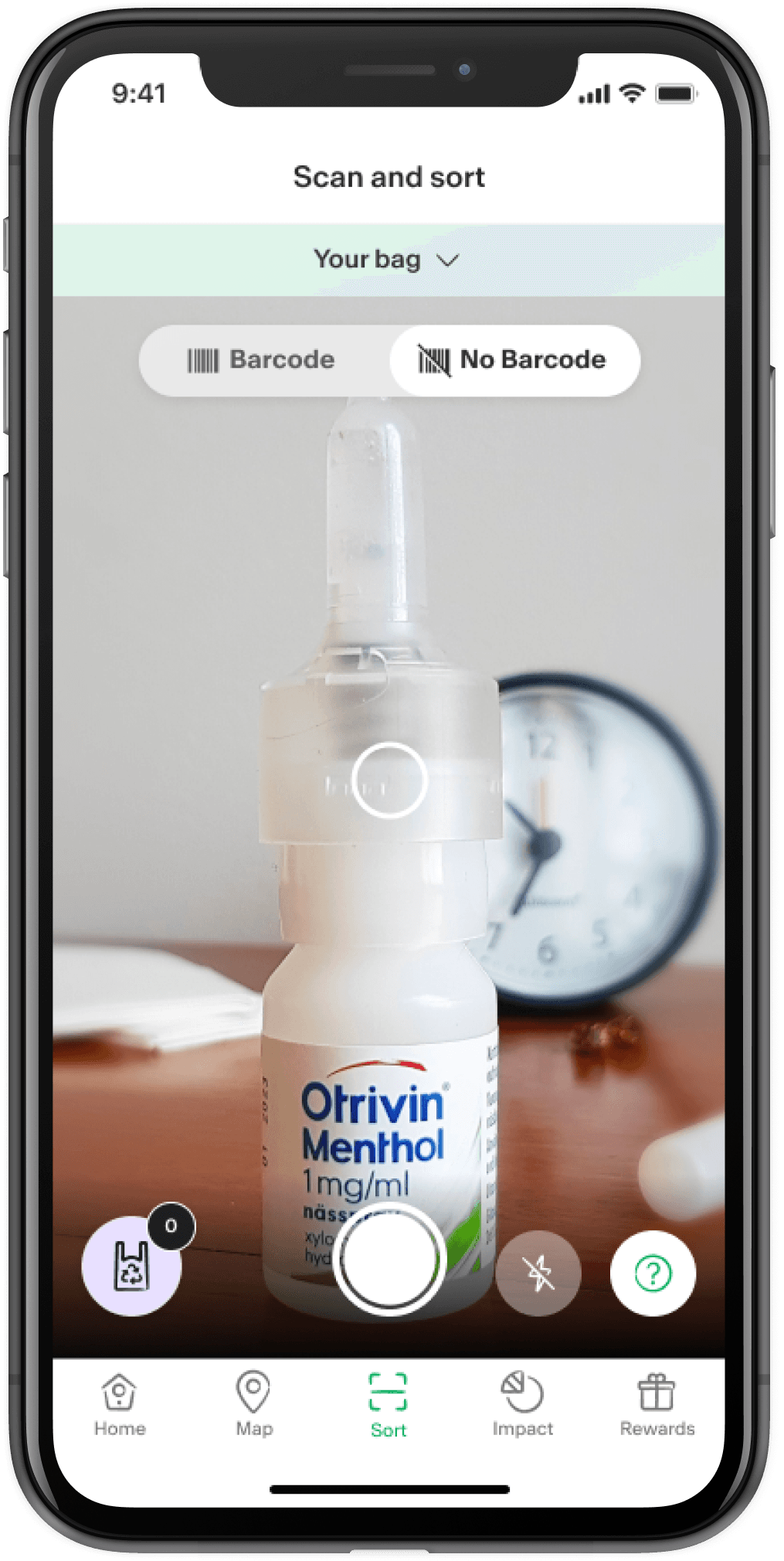
- Start collecting. A consumer walks in, scans the QR code on their empty bottle, hands over the container, and receives the deposit refund instantly in their UPI wallet. The kirana sees the collection commission credited in real time.
There is no training period. No specialized equipment. No inspection or certification. No recurring technology fee. The marginal cost of adding one more kirana to the collection network is the cost of printing a QR code.
This is what permissionless infrastructure looks like. Compare it to the franchise model used by most collection networks — application, approval, site inspection, equipment installation, training, ongoing compliance monitoring. That model adds 100 collection points per quarter with a dedicated team. The permissionless model can add 100 per hour.
Aggregation: How the Network Self-Organizes
Individual households generate too little recyclable waste to sustain direct pickup. This is the insight Recykal arrived at through painful operational experience: residential doorstep collection fails below 10 kg per day per generator.
The kirana model solves this by aggregating naturally. Fifty to 100 items per day per store is not a target that requires marketing or behavior change — it is what happens when a neighborhood of 200-500 households has a convenient return point on a route they already walk daily.
But the kirana is only the first node in the collection network. The full stack looks like this:
Kiranas (accept returns) — The first-mile touchpoint. Consumers return containers, receive deposit refunds. The kirana stores items in a basic bin or sack behind the counter. No sorting required at this stage.
Waste pickers (collect and sort) — India's 1.5 to 4 million waste pickers are the circulatory system of the informal recycling economy. Today, they earn Rs 4,000 to Rs 5,000 per month, working without contracts, price transparency, or access to the best-paying buyers. With direct platform access — transparent pricing, optimized pickup routes, digital payments — their earnings can reach Rs 8,000 to Rs 15,000 per month. A waste picker on the platform picks up from 10-15 kirana stores on a daily route, batched into efficient circuits by the app's routing logic.
Local hubs (sort and bale) — Small facilities where materials are sorted into granular categories, cleaned if necessary, and baled for transport. The Ambikapur model is instructive: 470 women organized into self-help groups operate 17 collection and sorting centers across the city, sorting waste into 156 categories. The result is a zero-landfill city. SHG-operated local hubs with deep sorting expertise are the template for this layer of the collection stack.
Regional aggregation — Baled materials from multiple local hubs are consolidated at regional facilities for transport to recyclers. This is where tonnage reaches the threshold that makes long-haul logistics economical.
Recyclers — The final destination. Material arrives sorted, baled, and documented with provenance data from the QR layer (Part 2 of this series), making it audit-ready for EPR compliance.
Each layer adds value. Each layer employs people who are already doing adjacent work. The network does not require construction — it requires coordination.
Proof of Concept: Kabadiwalla Connect and the Startup Ecosystem
This is not a thought experiment. The model has been partially proven.
Kabadiwalla Connect, a Chennai-based startup, mapped over 600 kabadiwallas — informal scrap dealers — across the city and connected them to a digital platform. The result: over 900,000 bottles collected per month through a network of operators who already had the relationships, the locations, and the operational knowledge. What they lacked was demand aggregation, price transparency, and digital coordination.
The kabadiwalla is a close cousin of the kirana in the collection stack. Both are neighborhood-level operators with existing physical spaces and daily customer relationships. The difference is that the kirana store handles the consumer return (the first mile), while the kabadiwalla traditionally handles the aggregation and onward sale (the second mile). A protocol that connects both — and makes the handoff between them seamless — captures the full collection value chain.
India's waste startup ecosystem is betting on exactly this architecture. Of the country's 1,411 waste management startups, 54% are located in Tier-II and Tier-III cities — exactly the markets where kirana density is highest and formal collection infrastructure is thinnest. These startups are not building RVMs. They are building coordination layers for cities that formal waste management has ignored.
The Swiggy Parallel: Logistics Coordination at Scale
If you want to understand what a mature collection network looks like operationally, look at Swiggy.
Swiggy coordinates over 130,000 delivery partners executing more than 1 million daily deliveries. The company does not own restaurants. It does not own vehicles. It does not employ the delivery partners as full-time staff. What it owns is the coordination layer — the matching algorithm, the routing logic, the payment rails, the reputation system.
The operational parallels to recycling collection are striking:
-
Multi-point routing. A waste picker picks up from 10 kirana stores and delivers to a sorting hub. Swiggy's ML-based routing system achieved a 20% reduction in delivery delays. The same class of algorithm — vehicle routing with time windows, capacity constraints, and dynamic demand — applies directly to collection logistics.
-
Real-time matching. Swiggy matches delivery demand to available riders in real time. A collection protocol matches kirana bin-fullness to available waste picker capacity. The data primitives are identical: location, availability, capacity, estimated time.
-
Reputation and quality. Swiggy rates delivery partners on speed and order accuracy. A collection protocol rates waste pickers on pickup reliability, material quality, and contamination rates. Both systems use reputation scores to allocate higher-value work to higher-performing participants.
-
Payment settlement. Swiggy settles payments between consumer, restaurant, and delivery partner per transaction. A collection protocol settles deposits between consumer, kirana, waste picker, and recycler per container. The settlement logic is more complex, but the infrastructure pattern is the same.
The point is not that recycling is the same as food delivery. The point is that the coordination technology for managing a large, distributed, multi-party logistics network already exists, already works at Indian scale, and does not need to be invented from scratch.
The Economics: Why Permissionless Wins
Three collection models, compared:
Model 1: Reverse Vending Machines — Capital cost per unit: Rs 4.75 lakh+. Annual operating cost: Rs 1.5-2.5 lakh (maintenance, connectivity, location rent). Throughput: 200-500 items/day per machine. Cost per item collected (Year 1): Rs 5-12. Coverage: one machine per several thousand people. Deployment speed: weeks per unit.
Model 2: Dedicated Collection Centers — Capital cost per center: Rs 3-8 lakh (lease deposit, fit-out, signage). Annual operating cost: Rs 4-6 lakh (staff, rent, utilities). Throughput: 500-2,000 items/day per center. Cost per item collected (Year 1): Rs 3-8. Coverage: one center per 5,000-10,000 people. Deployment speed: months per center.
Model 3: Kirana Network (Permissionless) — Capital cost per point: Rs 0. Annual operating cost per point: Rs 0 (commission is variable, paid per item). Throughput: 50-100 items/day per store. Cost per item collected: Rs 0.50-2 (pure variable cost). Coverage: one store per 100-200 people. Deployment speed: minutes per store.
Model 3 is not incrementally better. It is a different category. The per-item collection cost is 3-10x lower. The coverage density is 25-100x higher. The deployment speed is orders of magnitude faster. And the capital requirement is zero.
The trade-off is control. An RVM guarantees container scanning, material verification, and tamper-proof counting. A kirana collection point relies on the store owner to accept returns correctly and on the protocol's verification layer (QR scanning, photo confirmation, spot audits) to maintain integrity. This is a real challenge — but it is a software problem, not an infrastructure problem. Software problems get cheaper to solve over time. Infrastructure problems get more expensive.
Designing for the Informal Economy
Any collection model for India must account for the informal recycling economy. This is not optional. It is not a social-impact add-on. The informal sector is the recycling industry in India.
India's 1.5 to 4 million waste pickers collect, sort, and sell approximately 20% of the country's municipal waste. They operate without contracts, without price visibility, and without safety equipment. They earn Rs 4,000 to Rs 5,000 per month on average. They are among the most productive recycling workers in the world by volume-per-person, and among the worst compensated.
A permissionless collection network does not displace waste pickers. It gives them leverage.
Price transparency. Today, a waste picker sells to whichever aggregator is nearest, at whatever price is offered. There is no benchmark, no negotiation power. A platform that publishes real-time material prices — the way commodity exchanges publish crop prices — immediately shifts bargaining power toward the collector.
Route optimization. A waste picker currently walks a route determined by habit and local knowledge. A platform showing kirana bin-fill levels in real time allows the same worker to cover more stores per day, skip empty stops, and focus on high-value material categories.
Direct access to better buyers. The informal chain has three to four intermediaries between the waste picker and the recycler, each taking a margin. A platform that connects waste pickers directly to sorting hubs — even skipping one intermediary — can double their effective earnings.
Digital payment trails. Cash-based transactions leave no record. A digital payment trail creates a work history, a credit record, and a path toward financial inclusion — microloans, insurance, savings products.
The Ambikapur SHG model shows where this leads: 470 women, 17 centers, 156 sorting categories, stable income, and zero-landfill status. The kirana-to-hub-to-recycler stack is the digital equivalent — a structured system that integrates informal workers rather than replacing them, and rewards them with better economics for participating in a transparent network.
What We Are Actually Building
Summarizing the collection layer of the Recycling Stack:
A consumer finishes a bottle. They walk to their nearest kirana store — the one they already visit daily for milk, bread, or phone recharges. They scan the QR code on the bottle with their phone. The deposit refund arrives in their UPI wallet in under three seconds. They hand the bottle to the store owner and leave.
The store owner places the bottle in a bin behind the counter. When the bin is near-full, the app signals a waste picker on an optimized route. The waste picker arrives, scans the bin's QR code, picks up the material, and receives a pickup payment. They transport the material to a local sorting hub.
At the hub, an SHG-organized team sorts the material into granular categories. Each sorted bale is tagged with provenance data — which store, which waste picker, which material type, which timestamp. The bale is weighed, recorded, and staged for regional transport. A regional aggregator collects bales from multiple hubs, consolidates them, and delivers to a recycler. The recycler receives material that is sorted, verified, and documented. The EPR compliance data flows automatically to the brand that originally produced the packaging.
Every participant earns at every step. The consumer recovers their deposit. The kirana earns a commission. The waste picker earns a pickup fee and a per-kilogram rate. The hub earns a sorting margin. The aggregator earns a transport margin. The recycler gets clean, verified feedstock. The brand gets EPR compliance without chasing paperwork.
This is not a supply chain. It is a protocol — open, permissionless, and self-reinforcing.
Uber did not build cars. Airbnb did not build hotels. A recycling protocol does not build collection points — it activates 12 million that already exist.
12 million stores. No capex. No franchise. The network already exists — it just needs a protocol to plug into. In Part 6, we'll design that protocol to be permissionless.
Related Resources
Why Deposits Beat Rewards: The Behavioral Science India Needs to Hear
Deposit return schemes achieve 85-98% return rates globally. Reward programs plateau at 40-50%. The difference is loss aversion. Here's the data India is ignoring.
14,450 Tonnes a Day: The Plastic Crisis Burying the Himalayas
The Indian Himalayan Region generates 14,450 tonnes of waste daily. 71% is non-recyclable plastic. PepsiCo is the #1 polluter for the third year. An investigative look at the crisis.
India Just Mandated QR Codes on Every Plastic Container. Nobody Has the Infrastructure.
Rule 11A requires QR codes on all plastic packaging by July 2025. 50,000+ brands are registered. Most have no QR infrastructure. This is the Y2K of Indian packaging.
India's 4 Million Invisible Recyclers Deserve More Than Rs 5,000 a Month
India's informal waste sector performs 100% of all recycling, achieves 70% PET collection, saves municipalities Rs 54.75 crore annually — yet earns Rs 4-5K/month with zero social security.
QR Codes on Every Container: What Factory Floors Actually Need
Rule 11A mandates QR codes on all plastic packaging. This practical guide covers printers, formats, speeds, costs, and integration for production line managers.
Deposit Return Scheme in India: The Complete Guide [2026]
Everything you need to know about Deposit Return Schemes (DRS) in India — how they work, global success rates, India's rollout in Goa and Kerala, behavioral science behind deposits, and how BIN is building the infrastructure.